Decentralized finance (DeFi) has been one of the most disruptive — and controversial — innovations in the blockchain ecosystem. It promises open access, programmable money, permissionless lending and borrowing, and new financial primitives that never existed in traditional banking.
But DeFi also carries significant risk.
Unlike traditional finance, there is often no bank, regulator, or customer protection agency ready to step in when something goes wrong. When funds disappear, they usually disappear permanently.
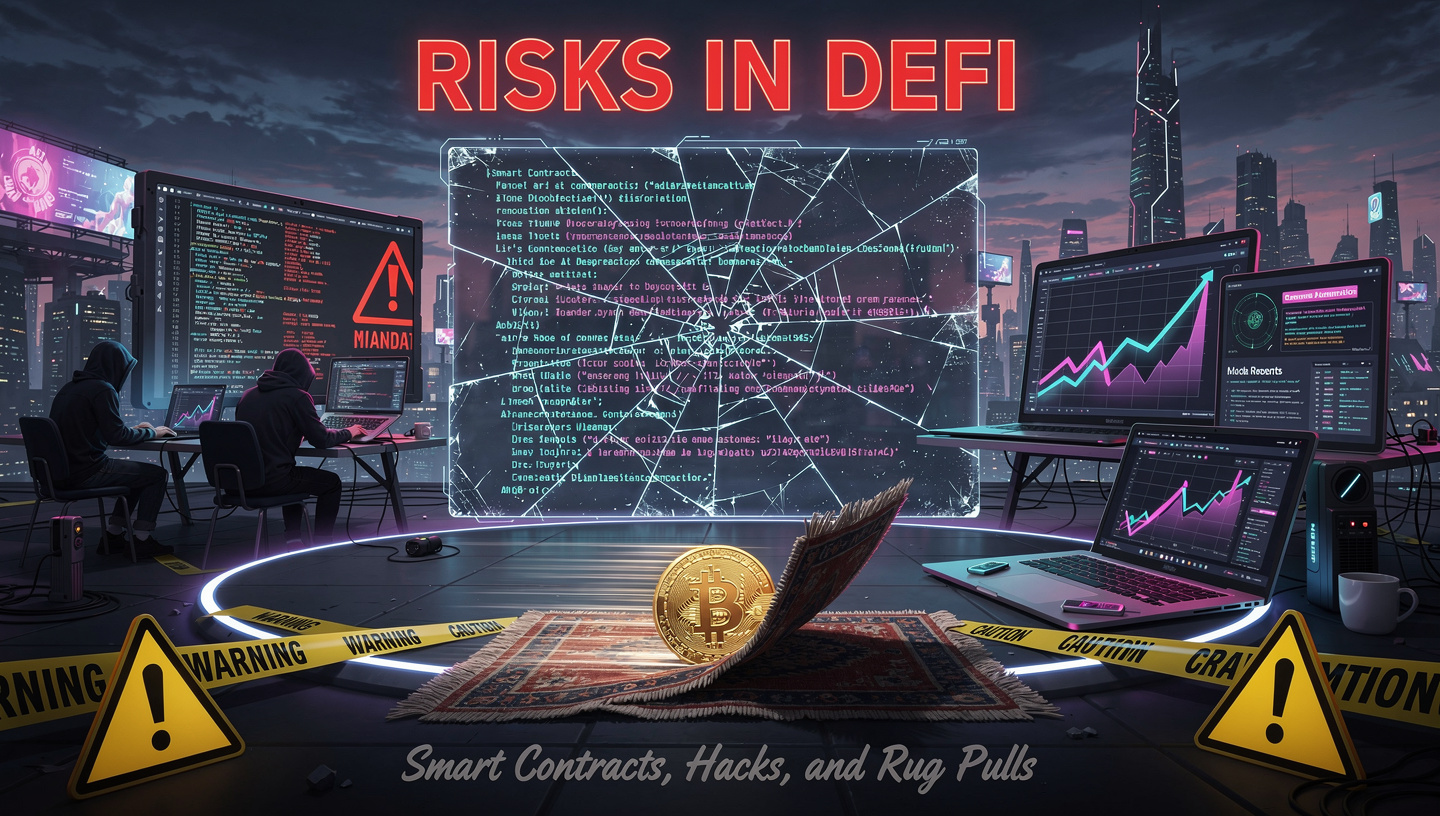
In this article, we will examine the architecture of DeFi risk:
what it is, how it happens, why it matters, and what users can do to reduce exposure. We will focus specifically on three core areas:
- Smart contract vulnerabilities
- DeFi hacks and exploits
- Rug pulls and outright fraud
The goal is not to scare people away from DeFi — but to replace hype with realism, and curiosity with informed caution.
What Makes DeFi Risky in the First Place?
Before diving into specific risks, it helps to understand why DeFi is inherently fragile compared to traditional systems.
1. Code replaces institutions
In DeFi, code handles actions normally performed by banks:
- custody of assets
- settlement and clearing
- loan underwriting
- liquidation rules
- reward distribution
Code is objective — but it is also unforgiving.
If a programmer makes a mistake, that mistake becomes part of the financial infrastructure.
2. Everything is interconnected
DeFi protocols are often “money Legos.”
One protocol relies on another, which relies on another, which relies on price feeds, liquidity pools, bridges, and exchanges.
When one component breaks, shockwaves can ripple across the entire ecosystem.
3. No central authority
There is no help desk to reverse transactions.
There is no fraud department to reimburse you.
There is no regulator standing behind the system.
This freedom is empowering — and dangerous.
Smart Contract Risks: When Code Becomes a Liability
At the core of DeFi are smart contracts — self-executing programs that run automatically when specific conditions are met.
They are powerful — but not perfect.
Common Smart Contract Vulnerabilities
1. Logic errors
The developer writes code that behaves differently than intended — often because of overlooked scenarios. A tiny logical flaw can expose millions of dollars.
2. Reentrancy bugs
A malicious actor repeatedly triggers a function before the first execution finishes, draining funds by looping the contract behavior.
3. Integer overflow/underflow
Numbers in smart contracts can exceed their allowed range, creating unexpected outcomes.
4. Permission misconfigurations
Developers accidentally leave hidden admin functions or allow external actors too much control.
5. Oracle manipulation
Smart contracts rely on external price feeds.
If attackers influence that data source, they can force the contract to behave incorrectly.
Why audits don’t solve everything
Audits are essential — but not magic shields. Even audited protocols have been exploited. Reasons include:
- audits miss complex interactions with other protocols
- rushed deployments bypass best practices
- upgrades introduce new bugs
- teams ignore auditor recommendations
- attackers continually evolve
In DeFi, “audited” means safer — not safe.
DeFi Hacks: Exploits at Scale
While software bugs create vulnerability, hacks convert risk into losses.
DeFi hacks typically fall into several categories:
1. Flash loan exploits
Attackers borrow massive capital with no collateral, manipulate market conditions temporarily, exploit a contract, profit, and repay the loan in the same transaction. The protocol remains empty — and the attacker walks away.
2. Liquidity pool manipulation
By skewing token balances or prices, attackers extract disproportionate value when other users interact with the pool.
3. Bridge exploits
Cross-chain bridges manage huge reserves and complex logic — making them frequent high-value targets.
4. Governance attacks
Decentralized governance can be hijacked when attackers accumulate enough voting power or use borrowed tokens to pass malicious proposals.
5. Key leaks and mismanagement
If a developer’s private keys are compromised, attackers can upgrade contracts or drain treasury funds.
Note: The point here is awareness — not instruction.
The deeper truth is that most hacks exploit predictable weaknesses: poor design, risky integrations, or inadequate security culture.
Rug Pulls: When Developers Disappear with the Money
Unlike hacks, rug pulls are deliberate fraud.
A team creates a token or protocol, markets it aggressively, promises huge yields — and then drains liquidity or abandons the project.
Types of Rug Pulls
1. Liquidity theft
Developers remove liquidity from a pool, leaving investors with worthless tokens.
2. Minting exploits (by design)
Developers retain minting privileges, issue massive new tokens, dump them on the market, and collapse the price.
3. Fake staking or “yield farms”
Rewards are promised, but withdrawal functions are intentionally broken or restricted.
4. Slow rugs
The team behaves legitimately at first, grows trust, then slowly extracts value through fees, treasury siphoning, or stealth dumping.
Rug pulls thrive because DeFi lowers entry barriers. Anyone can launch a token in minutes — and many do.
Behavioral Risks: The Human Factor
Technology isn’t the only weak point. Psychology plays a major role.
1. Greed and FOMO
Promises such as “1000% APY” short-circuit rational thinking.
2. Lack of diligence
Many investors skip research and trust influencers, anonymous forums, or hype marketing.
3. Misunderstanding risk
Users treat DeFi like a guaranteed savings account rather than a speculative experiment.
How to Reduce Risk Without Quitting DeFi Entirely
Risk cannot be eliminated. But it can be managed.
1. Evaluate the team
- Are founders public and verifiable?
- Do they have prior experience?
- Are contracts upgradeable, and who controls upgrades?
Anonymous teams are not always bad — but they require extra caution.
2. Review audits — carefully
Look for:
- multiple independent audits
- whether issues were fixed
- post-deployment monitoring
Avoid projects that rely only on “coming soon” audits.
3. Understand tokenomics
Be wary of:
- infinite minting
- heavy developer allocations
- unrealistic emission schedules
- no lockups
4. Check contract permissions
Who controls admin keys?
Is there a multisig?
Is ownership renounced?
Is there a timelock on upgrades?
5. Diversify
Never put all assets in one protocol, chain, or strategy.
6. Stay realistic about yields
If returns seem impossible in traditional finance, they often come from hidden leverage or unsustainable incentives.
The Future of DeFi Risk
DeFi will not disappear. It will evolve.
We will likely see stronger standards around:
- formal audits and continuous security monitoring
- safer contract templates
- improved insurance mechanisms
- better education and transparency
- stronger community governance safeguards
But users still carry responsibility. DeFi gives freedom — and requires discipline.
Final Thoughts
DeFi is not inherently good or bad. It is powerful.
Smart contracts reduce friction. Open financial rails create opportunity. Innovation moves fast.
However, ignoring the risks is naive.
When using DeFi, assume:
- the code may fail
- the incentives may break
- the team may not act ethically
- the money you deposit is genuinely at risk
Approach DeFi with curiosity, respect, and a rigorous risk-management mindset — and treat participation as an informed decision, not a guaranteed shortcut to profit.