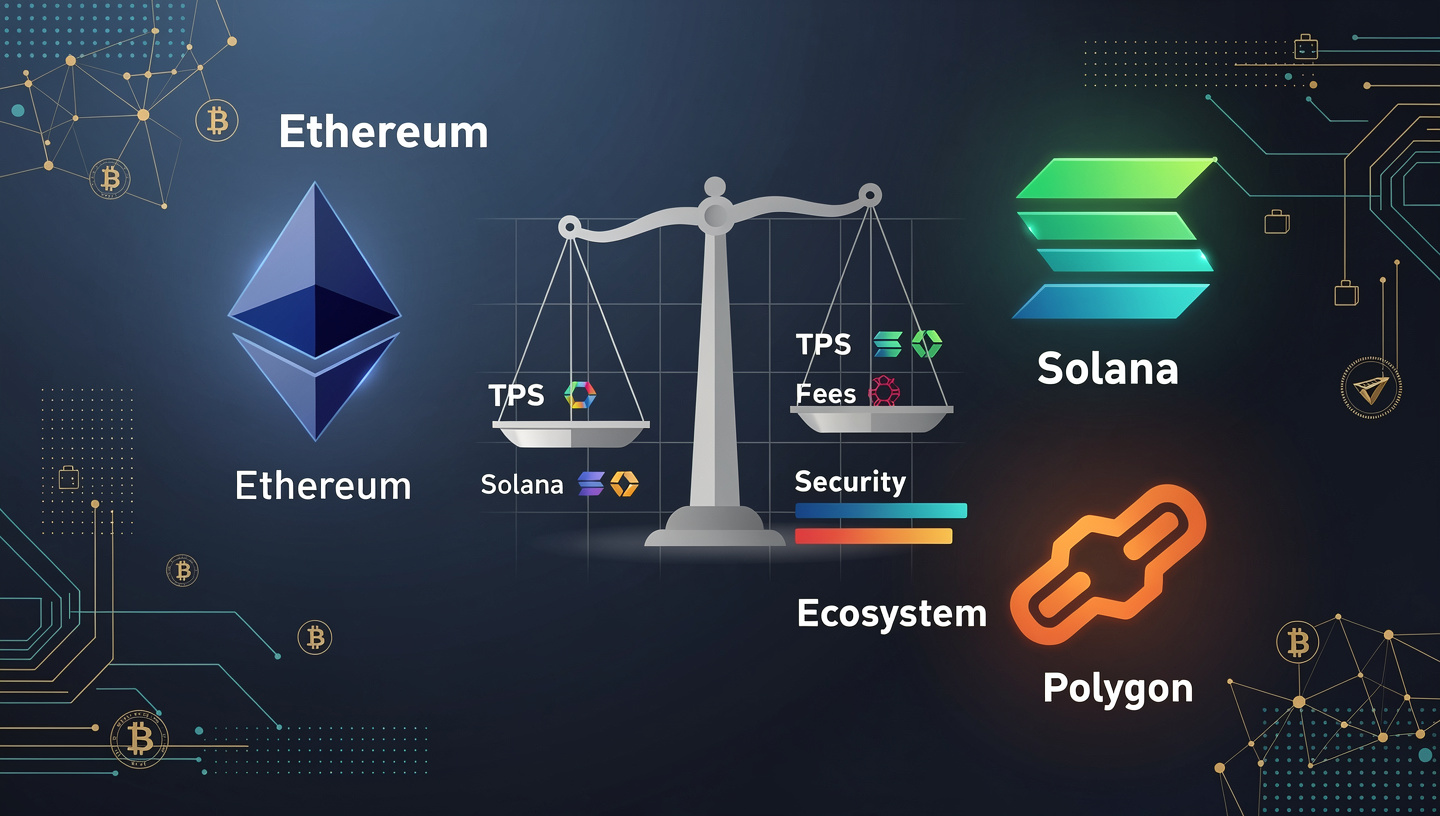
In the rapidly evolving blockchain ecosystem, three names consistently dominate conversations: Ethereum, Solana, and Polygon. Each seeks to deliver fast, secure, and scalable decentralized infrastructure — but they approach the challenge differently.
Investors, developers, builders, and curious learners often ask the same question:
Which blockchain is actually better — and for whom?
The answer is not simple. Each network carries its own design philosophy, technology trade-offs, advantages, and weaknesses. Choosing “the best” depends entirely on how the network will be used.
This article breaks everything down clearly, carefully, and objectively — so you can understand how these blockchains compete, where they excel, and where they fall short.
1. The Problem All Three Are Trying to Solve
Blockchains aim to be:
- Secure
- Decentralized
- Scalable
However, achieving all three simultaneously is extremely difficult. This tension is called the Blockchain Trilemma.
Most blockchains historically optimized for only two:
- Bitcoin prioritized security + decentralization, but sacrificed speed.
- Early Ethereum prioritized smart contracts and decentralization, but struggled to scale.
Solana and Polygon emerged with new approaches to scalability while trying to maintain security and usability.
2. Quick Overview
| Feature | Ethereum | Solana | Polygon |
|---|---|---|---|
| Launch Year | 2015 | 2020 | 2017 |
| Main Purpose | Smart contract pioneer, decentralized ecosystem foundation | High-speed, low-cost blockchain | Scaling layer for Ethereum |
| Transactions per Second (approx.) | ~15–30 on main chain | Up to thousands | Depends on chain type |
| Fees | Higher during congestion | Very low | Very low |
| Decentralization | Very high | Lower than Ethereum | Inherits Ethereum security depending on chain |
| Developer Ecosystem | Largest in blockchain | Growing rapidly | Strong, closely tied to Ethereum |
3. Ethereum: The Original Smart Contract Powerhouse
What Ethereum Does Best
Ethereum is the foundational smart contract platform that powered:
- Decentralized Finance (DeFi)
- NFTs
- DAOs
- Tokenization
- Web3 infrastructure
It is highly trusted and battle-tested.
Key strengths:
- Security
Ethereum is one of the most secure blockchains due to:- Thousands of validators globally
- Mature tooling
- Long history of audits and testing
- Decentralization
No central entity controls Ethereum. This matters for:- Long-term censorship resistance
- Institutional trust
- Regulatory confidence
- Massive Developer Ecosystem
More developers build on Ethereum than any other chain. This produces:- Faster innovation
- Better documentation
- More integrations and tooling
Where Ethereum Struggles
Historically, Ethereum struggled with:
- Slow transaction speed
- High gas fees during peak times
This created a poor user experience for smaller users.
How Ethereum Is Improving
Ethereum is evolving with:
- Layer-2 scaling solutions (Arbitrum, Optimism, zkSync, etc.)
- Upgrades aimed at performance and efficiency
- Rollups, sharding concepts, and cryptographic optimizations
Rather than trying to be the fastest chain, Ethereum is becoming a secure settlement layer, with faster activity moving to layers built above it.
4. Solana: Speed First, Everything Else Second
Solana’s Core Idea
Solana was designed to demonstrate that blockchains can be:
- Extremely fast
- Extremely cheap
- Consumer-friendly
It uses innovative mechanisms like Proof of History to order transactions more efficiently.
What Solana Does Well
- High Throughput
Solana can handle thousands of transactions per second. - Low Fees
Transaction costs are often fractions of a cent. - Growing Consumer Apps
Solana has attracted real-world applications:- Payment systems
- Gaming
- NFTs
- Social applications
Its user experience often feels closer to traditional web apps.
Solana’s Trade-Offs
However, speed comes with compromises:
- Fewer validators than Ethereum
- Occasional network outages historically
- Greater reliance on larger, more powerful hardware
These factors can reduce decentralization.
In short: Solana prioritizes performance, sometimes at the expense of architectural purity.
5. Polygon: Scaling Ethereum, Not Replacing It
What Makes Polygon Different
Polygon is not primarily a competitor to Ethereum. Instead, it is a scaling ecosystem built to support Ethereum.
It offers different chain types:
- Sidechains
- Layer-2 rollups
- Zero-knowledge scaling solutions
Key Advantages of Polygon
- Low Fees + Compatibility
Polygon provides faster and cheaper transactions while remaining compatible with Ethereum tools and wallets. - Developer-Friendly
Developers can migrate Ethereum apps with minimal changes. - Flexible Infrastructure
Teams can choose the chain type that suits their needs:- High performance
- Greater security
- Hybrid architectures
Polygon’s Weaknesses
- Security depends on architecture chosen
- Sometimes more complex than other chains
- Not as decentralized as Ethereum layer-1
Polygon succeeds not by replacing Ethereum, but by extending its reach.
6. Developer Ecosystem Comparison
Ethereum
Largest, most mature, most trusted.
Solana
Fast-growing, innovative, strong tooling improving.
Polygon
Benefits from the existing Ethereum developer base.
Result:
- If you want security and ecosystem depth → Ethereum wins
- If you want performance and consumer UX → Solana wins
- If you want Ethereum compatibility with scaling → Polygon wins
7. Fees and User Experience
| Category | Ethereum | Solana | Polygon |
|---|---|---|---|
| Fees | Can be high during congestion | Extremely low | Very low |
| Speed | Moderate | Very fast | Fast |
| Ideal Users | Institutions, large DeFi, secure protocols | Mass-market apps, payments, gaming | Everyday users, DeFi, bridges, NFTs |
Ethereum is excellent for value security and long-term settlements. Solana and Polygon are better for everyday interactions where cost sensitivity matters.
8. Which Network Is Better — Final Verdict
There is no absolute winner. Each network is optimized for different objectives.
Choose Ethereum if you value:
- Maximum decentralization
- Security
- Institutional trust
- Long-term infrastructure stability
Choose Solana if you value:
- Speed
- Low costs
- Consumer-grade applications
- Simple, fast UX
Choose Polygon if you value:
- Ethereum compatibility
- Affordable scaling
- Flexible development options
- Hybrid architecture benefits
Final Thoughts
Blockchain ecosystems are not a zero-sum game. These networks can coexist, integrate, and complement each other.
- Ethereum acts as the global settlement layer.
- Polygon expands Ethereum’s reach and scalability.
- Solana experiments aggressively with speed and usability.
Rather than asking, “Which blockchain will win?” a more accurate question is:
Which blockchain best fits the specific use case?
That is where real strategic thinking begins.