If you have spent any time around blockchain, crypto, or Web3 conversations, you have probably heard the phrase smart contracts used again and again. They are often described as the “engine” behind decentralized applications, NFTs, DeFi platforms, DAOs, and countless other innovations.
But the term itself can be misleading.
Smart contracts are not “smart” in the sense of artificial intelligence, and most of the time, they are not legal “contracts” in the traditional sense. Instead, they are something more pragmatic — and arguably more powerful:
Smart contracts are self-executing programs that run on a blockchain and automatically enforce rules without requiring intermediaries.
This article will walk through:
- What smart contracts actually are
- Why they matter
- How they work technically (without drowning in jargon)
- Key benefits and risks
- Real-world examples across multiple industries
- What the future might look like
Let’s start from first principles.
1. What Exactly Is a Smart Contract?
A smart contract is a piece of code stored on a blockchain (like Ethereum) that executes automatically when predefined conditions are met.
Think of it as:
“If X happens, automatically do Y — and nobody can cheat the process.”
A simple analogy:
Imagine a vending machine.
- You insert money.
- You select a drink.
- The machine validates the input.
- If conditions are satisfied, it delivers the drink.
- If not, it refunds you.
There’s no cashier. No negotiation. No manual oversight.
A smart contract works the same way — except instead of soda, it might release funds, transfer ownership of a token, verify identity credentials, or record supply-chain data.
2. Why Smart Contracts Matter: The Shift From Trust to Code
Traditionally, society relies on trusted intermediaries:
- Banks move money
- Lawyers draft agreements
- Escrow agents hold funds
- Governments maintain records
- Platforms like Airbnb or Uber mediate transactions
Intermediaries provide trust — but they also introduce:
- Cost (fees, commissions, legal expenses)
- Friction (processing delays, paperwork)
- Risk (corruption, fraud, censorship, manipulation)
- Centralized control
Smart contracts replace institutional trust with mathematical and programmatic enforcement.
Instead of saying:
“Trust the bank.”
We now say:
“Trust the code. Trust the blockchain.”
That shift is radical — and controversial — but it is the foundation of decentralized systems.
3. How Smart Contracts Work (Without Getting Lost in Code)
At a high level, here is the lifecycle.
Step 1: A Developer Writes the Contract
Typically using languages such as:
- Solidity (Ethereum)
- Vyper (Ethereum alternative)
- Rust (Solana, NEAR)
- Move (Aptos, Sui)
The contract defines:
- Inputs (conditions)
- Logic (what happens when conditions are met)
- Outputs (state changes, payments, ownership transfers)
Step 2: Contract Is Deployed to the Blockchain
Deployment means:
- The code is stored on the network permanently.
- Every node has a copy.
Once deployed, it cannot easily be changed unless designed with upgrade mechanisms.
Step 3: Users Interact with the Contract
Interaction happens through:
- Wallets (MetaMask, Phantom, etc.)
- Decentralized applications (dApps)
- Other contracts
Each interaction is recorded as a transaction.
Step 4: Miners/Validators Execute the Contract
They:
- Verify input
- Run computations
- Reach consensus
- Record the result immutably
At that point, the outcome is final.
No bank. No administrator. No central authority.
4. Key Advantages of Smart Contracts
1. Automation
Once deployed, contracts run themselves.
No approvals, paperwork, or back-and-forth emails.
2. Transparency
Code is public. Anyone can audit it.
Rules are clear, upfront, and impossible to alter secretly.
3. Security and Integrity
Blockchain immutability makes it difficult to tamper with records.
Fraud is significantly harder.
4. Cost Reduction
Eliminating intermediaries reduces operational overhead and settlement costs.
5. Global Access
Anyone with an internet connection and wallet can participate.
This opens new possibilities for financial inclusion.
5. The Risks and Limitations
Smart contracts are not magic. They introduce their own challenges.
1. Bugs in Code
If the logic is flawed, the contract will still execute — exactly as written.
History has shown that vulnerabilities can result in major financial losses.
2. Irreversibility
Blockchain transactions are final.
If funds are sent to the wrong contract or exploited, reversing them is often impossible.
3. Legal Uncertainty
Are smart contracts legally enforceable everywhere?
Not consistently. Laws are evolving, and jurisdictional complexity remains.
4. Dependency on External Data (Oracles)
Smart contracts cannot natively “see” real-world events.
They depend on oracles for things like:
- Market prices
- Weather data
- Shipping confirmations
- Sports outcomes
If the oracle is compromised, the contract outcome may be manipulated.
5. User Experience Barriers
Wallets, gas fees, private keys — these concepts are still difficult for mainstream users.
The technology is powerful, but still maturing.
6. Real-World Examples of Smart Contracts in Action
Now let’s ground this in concrete use cases.
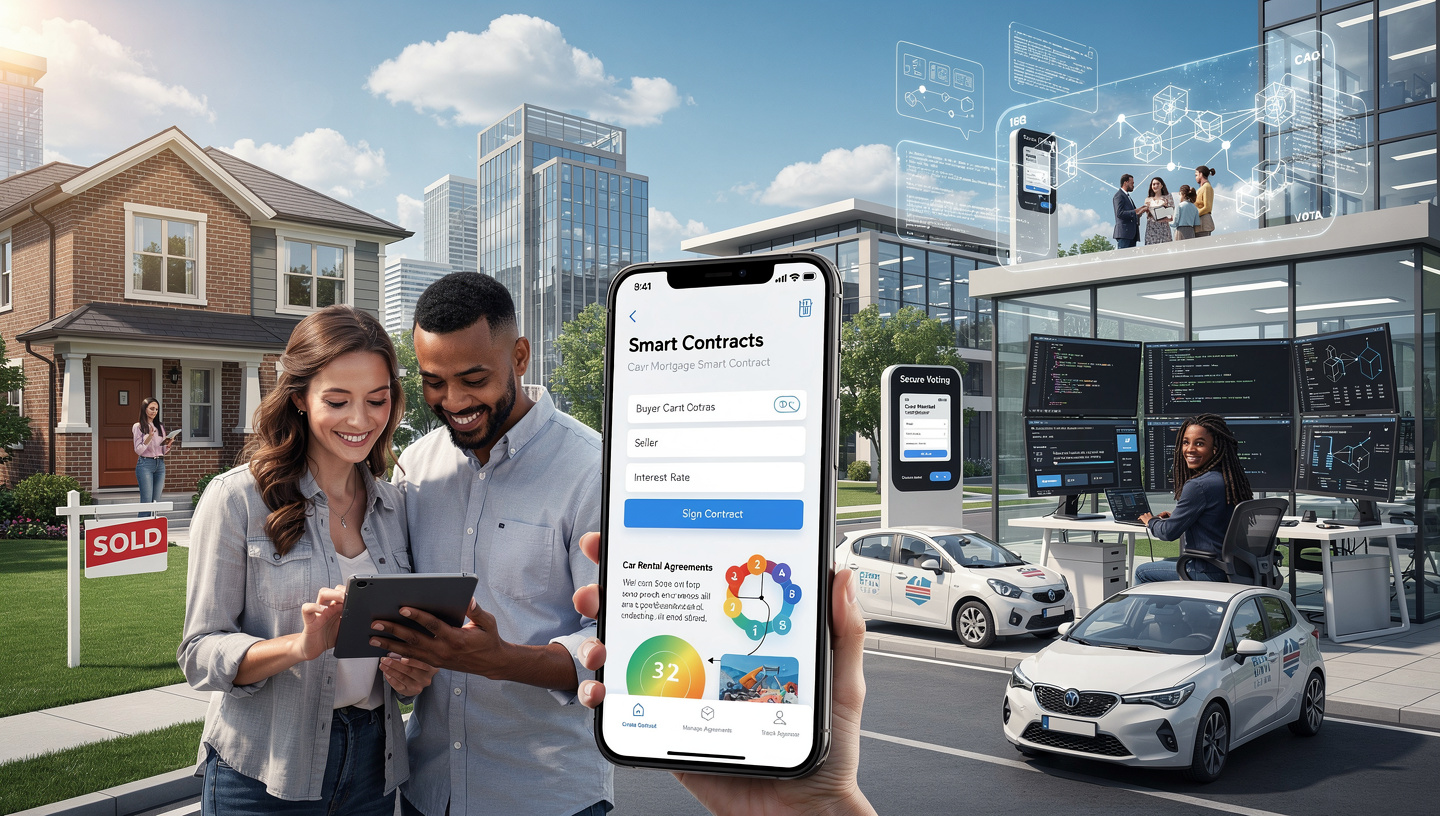
Example 1: Decentralized Finance (DeFi) Lending
Traditional lending:
- Apply
- Get credit score checked
- Wait for approval
- Sign paperwork
- Pay interest and bank fees
Smart contract lending (e.g., Aave, Compound):
- Deposit crypto as collateral
- Borrow instantly
- Liquidation is automatic if collateral value drops
No bank. No lengthy approval process.
Example 2: NFT Royalties for Artists
In traditional media:
- Artists rely on publishers and intermediaries
- Royalties are delayed and opaque
Smart contract NFTs allow:
- Automatic royalty payments each time the work is resold
- Transparent tracking of ownership
- Direct distribution to creators
The code enforces royalty logic — consistently, forever.
Example 3: Supply Chain Tracking
Companies use smart contracts to:
- Log production batches
- Verify authenticity (pharmaceuticals, luxury goods)
- Confirm delivery events
For example:
- A shipment leaves a port.
- An IoT device logs its location to the blockchain.
- The smart contract releases payment only once delivery is verified.
This reduces fraud, counterfeiting, and disputes.
Example 4: Real Estate Tokenization
Property transactions are usually slow, expensive, and paper-heavy.
Smart contracts enable:
- Digital ownership tokens representing property shares
- Automated dividend distribution from rental income
- Faster secondary trading
Instead of weeks, settlement could happen in minutes.
Example 5: Insurance Claims
Traditional claims involve manual review and subjective risk assessment.
Parametric insurance via smart contracts works differently.
Example:
- Farmers buy drought insurance.
- A weather oracle confirms rainfall below a threshold.
- The smart contract automatically pays out.
No adjusters, no delays, minimal disputes.
7. Are Smart Contracts Really “Contracts”?
Sometimes, yes — but not always.
They do not inherently include:
- Legal language
- Jurisdiction clauses
- Dispute resolution
Instead, they primarily enforce execution logic.
Increasingly, hybrid frameworks combine:
- Legal agreements (off-chain)
- Automated performance (on-chain)
This convergence is where the technology becomes practical for enterprises.
8. The Future: Where Smart Contracts Are Headed
Several trajectories are emerging.
1. More User-Friendly Abstractions
Users will interact with applications, not code.
Complex wallet management may disappear behind intuitive interfaces.
2. Cross-Chain Interoperability
Smart contracts across multiple blockchains will communicate seamlessly.
3. Regulatory Integration
Governments and enterprises are exploring:
- Digital identity
- On-chain registries
- Compliance-aware smart contracts
4. Enterprise Adoption
Sectors showing momentum:
- Finance
- Logistics
- Healthcare
- Energy markets
- Intellectual property
The trajectory is clear: automation moves closer to the core of business processes.
Final Thoughts: Smart Contracts Are Infrastructure, Not Hype
Smart contracts are often misunderstood as a speculative trend.
In reality, they represent:
- A new coordination mechanism
- A programmable layer for trust
- A foundation for decentralized systems
They are not perfect, and the ecosystem still faces real engineering, legal, and societal challenges.
But their value proposition — automation, transparency, global access, and minimized reliance on intermediaries — is transformational.
We are still early in the adoption curve. Yet, as real-world applications expand, smart contracts are steadily transitioning from theory to infrastructure.