If you are just getting started in cryptocurrency, the first big question usually arrives much faster than you expect:
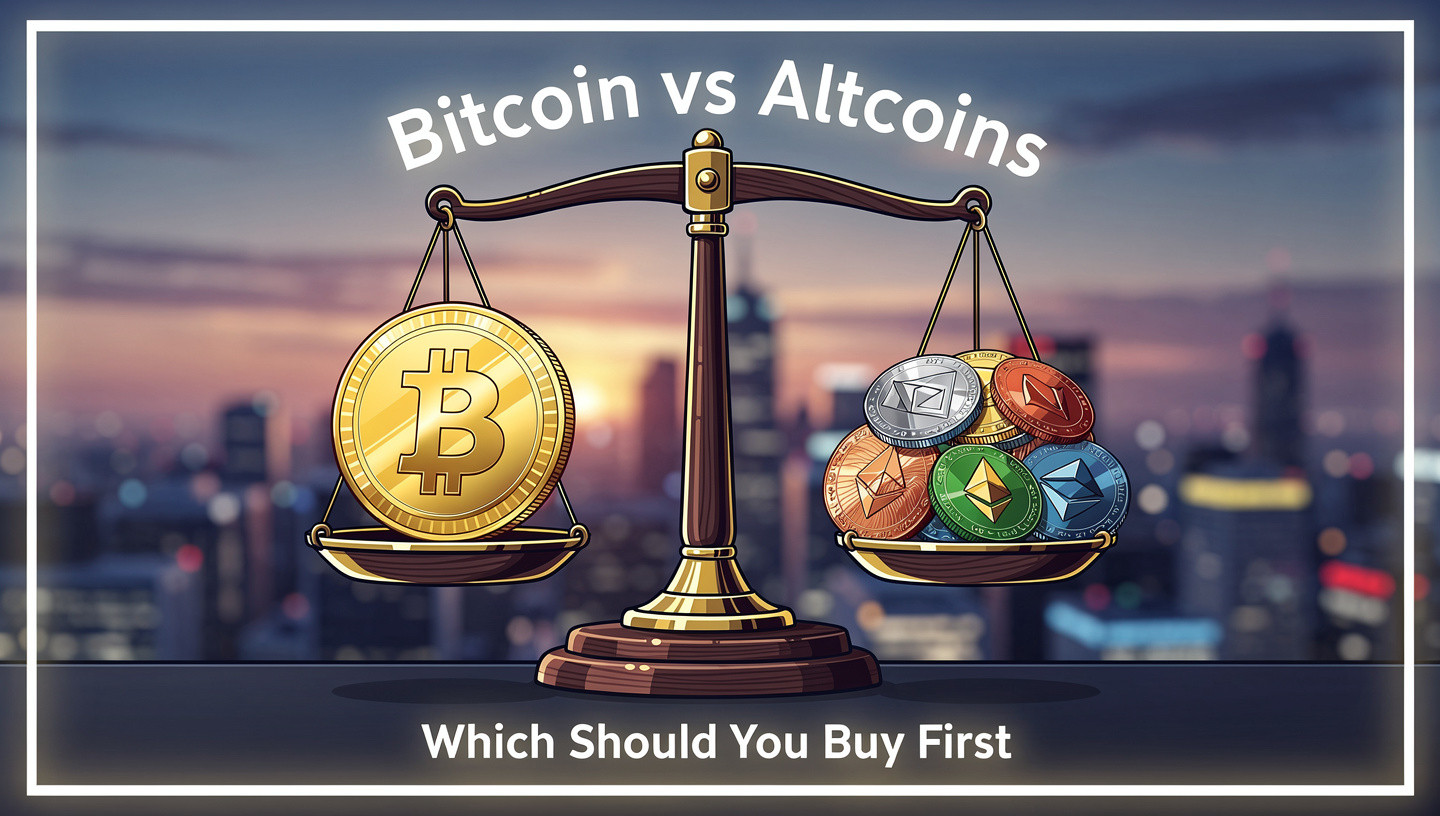
Should I buy Bitcoin first… or jump straight into altcoins?
On the surface, this might feel like a simple comparison:
- Bitcoin = safer, slower, older
- Altcoins = newer, riskier, higher upside
But that view is incomplete.
The real decision involves:
- understanding what Bitcoin actually is
- understanding what altcoins try to do differently
- evaluating risk vs potential reward
- aligning choices with your financial goals and risk tolerance
This article will walk you through that entire thought process.
By the end, you will have a structured, thoughtful way to answer the question for yourself — without relying on hype, fear, or blind guessing.
Let’s start with foundations.
Part 1: What Exactly Is Bitcoin?
Bitcoin is not just “a coin” or “an investment.”
Bitcoin was designed to be:
a decentralized, censorship-resistant digital money, independent from governments and banks.
It launched in 2009, created by the mysterious figure (or group) known as Satoshi Nakamoto.
Bitcoin solves a fundamental digital problem:
How do you transfer value over the internet without relying on any central authority to verify it?
The innovation is the blockchain — a distributed public ledger where:
- thousands of computers verify transactions
- no single person or organization controls the network
- all transactions are transparent and immutable
Because of its design:
- Bitcoin has the longest track record in crypto
- It has the largest market capitalization
- It is the most widely recognized and adopted
- It is often seen as “digital gold”
Over time, Bitcoin has evolved from “internet money for daily payments” into something closer to a store of value, similar to gold — scarce, durable, and difficult to manipulate.
Key characteristics of Bitcoin
- Fixed supply – only 21 million BTC will ever exist
- Highly secure network powered by Proof of Work
- Decentralized and leaderless
- Transparent and auditable
- Deep liquidity (easy to buy, sell, convert)
Because of these characteristics, investors often see Bitcoin as the base layer of crypto investing.
But then came something new…
Part 2: What Are Altcoins?
Altcoins simply means:
Any cryptocurrency that is NOT Bitcoin.
Ethereum, Solana, Cardano, XRP, Polygon, Dogecoin, Avalanche — they are all altcoins.
Altcoins exist because developers looked at Bitcoin and asked:
“What else can blockchain technology do?”
Some altcoins aim to:
- improve speed or scalability
- offer smart contracts and applications
- create decentralized finance systems
- power online games and virtual worlds
- build new digital identity or infrastructure layers
In short, altcoins are experiments — some brilliant, some unnecessary, some outright scams.
Types of altcoins
Not all altcoins are built for the same purpose. Broad categories include:
- Smart contract platforms
Ethereum, Solana, Avalanche, Cardano
These are programmable blockchains where developers build decentralized apps. - DeFi tokens
Uniswap, Aave, MakerDAO
These power decentralized exchanges or lending/borrowing protocols. - Utility tokens
Tokens used within specific ecosystems — like paying fees or accessing services. - Meme coins
Dogecoin, Shiba Inu — driven mostly by community hype rather than utility. - Stablecoins
USDT, USDC — pegged to fiat currencies to reduce volatility.
Why people are attracted to altcoins
Altcoins are attractive because:
- They can grow faster than Bitcoin
- They often cost less per coin (psychologically appealing)
- They allow exposure to emerging technologies
- They sometimes offer extremely high returns
But…
higher upside usually comes with higher risk.
Altcoins can rise 500% in a month — and crash 90% just as fast.
Part 3: Bitcoin vs Altcoins — Core Differences
Let’s analyze the decision from several dimensions.
1. Risk Profile
Bitcoin:
- More stable relative to crypto market
- Less likely to disappear
- Still volatile, but historically resilient
Altcoins:
- Many will never recover after crashes
- Projects can fail, get abandoned, or be hacked
- Large potential gains — but real risk of total loss
2. Purpose and Use Case
Bitcoin:
Primarily money + store of value.
Altcoins:
Multiple experiments — finance, gaming, infrastructure, ecosystems.
3. Track Record
Bitcoin:
Over 15 years of operation without shutdown.
Altcoins:
Most are less than 5 years old and unproven long-term.
4. Supply and Scarcity
Bitcoin:
Fixed supply — predictable, deflationary.
Altcoins:
Many have flexible or inflationary supply models.
5. Institutional Adoption
Bitcoin is widely held by:
- hedge funds
- public companies
- some governments
- financial institutions
Altcoins have adoption — but far less institutional trust.
Part 4: Arguments for Buying Bitcoin First
Here is the strongest logical case for starting with Bitcoin.
1. Foundation of the Crypto Market
Bitcoin is the entry point for most investors.
If the entire crypto market collapses, Bitcoin typically survives longest.
2. Easier to Understand
The narrative is straightforward:
- scarce digital asset
- hedge against inflation
- long-term store of value
- decentralized global money
You can understand Bitcoin without needing deep technical expertise.
3. Lower Probability of Going to Zero
Bitcoin has:
- no CEO
- no company
- no central control
- huge global miner network
Nobody can simply “turn off” Bitcoin.
4. Builds Discipline Before Speculation
Beginning with Bitcoin helps new investors learn:
- how wallets work
- how exchanges operate
- how volatility feels emotionally
- how to hold long-term
This foundation reduces mistakes later.
Part 5: Arguments for Considering Altcoins
Altcoins are not useless. They exist for real reasons.
1. Innovation and Technology
Altcoins power innovation such as:
- smart contracts
- decentralized applications
- DeFi
- NFTs
- Web3 ecosystems
If you believe in blockchain technology beyond money, altcoins expose you to that growth.
2. Higher Potential Returns
Because altcoins are earlier-stage assets, gains can be dramatically higher.
Example outcomes historically:
- Ethereum massively outperformed Bitcoin in some cycles
- Early investors in quality projects saw extraordinary upside
But always remember:
high reward always equals high risk.
3. Diversification Inside Crypto
Relying on just one asset concentrates risk.
Strategic exposure to a few high-quality altcoins can balance portfolios.
However — only if done carefully.
Part 6: The Smart Sequence for Beginners
After analyzing thousands of portfolios and market behaviors, a common framework emerges.
Step 1: Start with Bitcoin
Build a strong Bitcoin base first.
Many disciplined investors aim for:
50–80% of their crypto allocation in Bitcoin initially.
Why?
Because Bitcoin acts like the “anchor” in a storm.
Step 2: Add High-Quality Altcoins (Slowly)
Once you:
- understand security
- know how wallets work
- are comfortable with volatility
Then consider allocating a smaller portion into altcoins — typically:
10–30% depending on risk tolerance.
Focus on:
- established projects
- strong developer communities
- real use cases
- transparent leadership
Examples historically considered “higher-quality” include projects like Ethereum and major infrastructure networks. That does not mean “risk-free.” Nothing in crypto is risk-free.
Step 3: Avoid Random Gambling
Avoid buying coins simply because:
- someone hyped them on social media
- they are cheap per coin
- friends promise massive returns
- influencers claim “guarantees”
In crypto, if something sounds guaranteed, it is usually dangerous.
Part 7: Common Mistakes to Avoid
Mistake #1: Skipping Bitcoin Completely
Jumping directly into meme coins or speculative tokens is one of the fastest ways to lose capital.
Mistake #2: Over-Diversifying into Dozens of Altcoins
Owning too many low-quality tokens spreads risk — but also spreads attention, research, and conviction too thin.
Mistake #3: Emotional Trading
Buying because price is rising and panic-selling because price is falling leads to predictable losses.
Mistake #4: Investing Money You Cannot Afford to Lose
Crypto remains speculative. Always maintain financial discipline.
Part 8: So — Which Should You Buy First?
Here is a clear, practical conclusion:
If you are new to crypto:
Start with Bitcoin.
Build knowledge, confidence, and discipline first.
If you already understand crypto and accept higher risk:
Consider adding a limited, strategic allocation of high-quality altcoins alongside Bitcoin.
If you want stability inside crypto:
Lean heavily toward Bitcoin.
If you want growth with risk:
Blend Bitcoin with selective altcoins — but only after research.
Final Thoughts
Bitcoin is the foundation.
Altcoins are experiments layered on top of that foundation.
Choosing between them is not really “Bitcoin OR altcoins.”
The more intelligent approach is:
Bitcoin first.
Understanding next.
Selective altcoins later — carefully, patiently, intentionally.