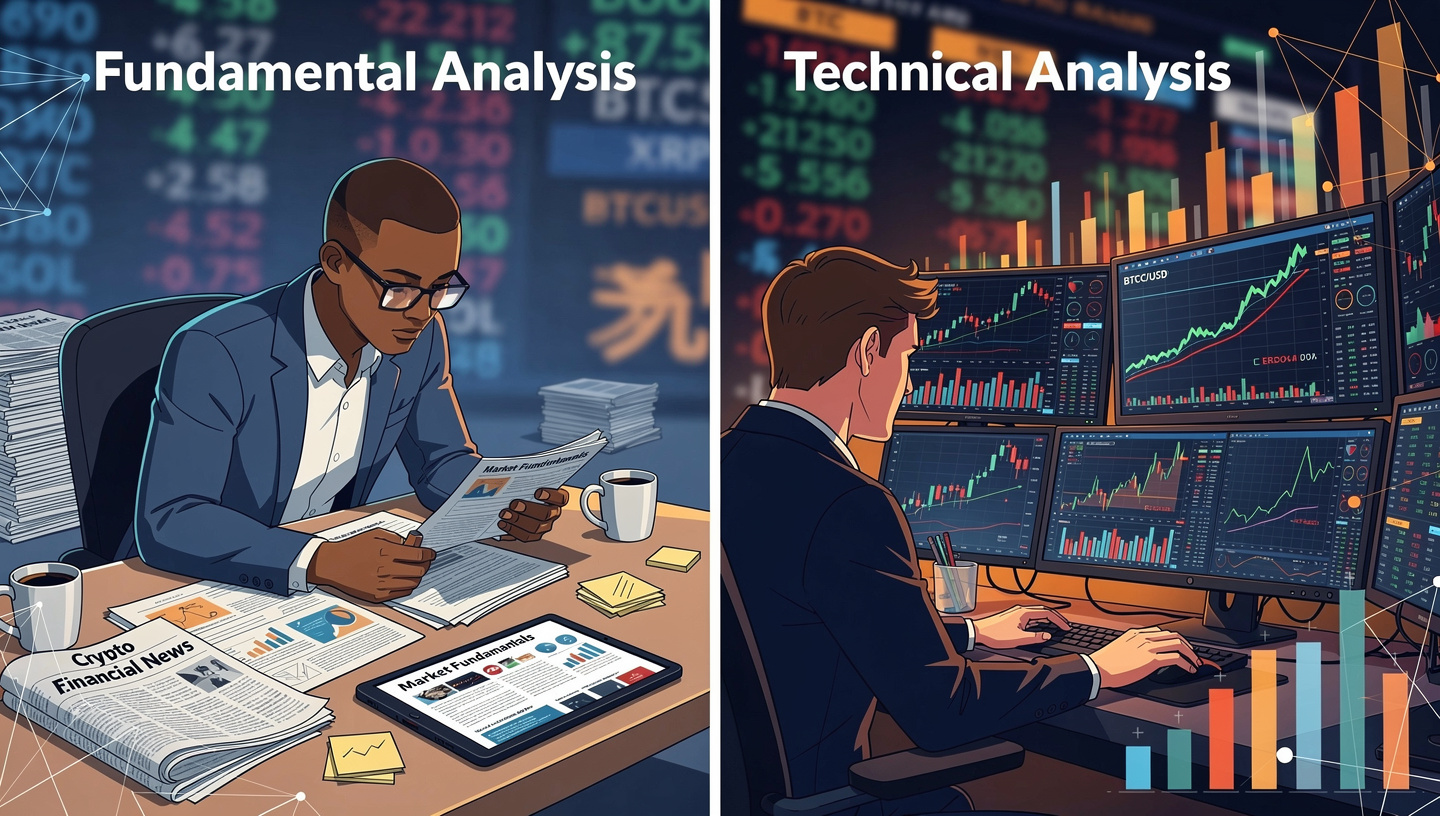
Cryptocurrency investors and traders eventually face a pivotal question:
Should I rely on fundamental analysis… or technical analysis?
In traditional finance, each discipline has decades of academic backing, empirical testing, and structured methodologies.
Crypto, however, is younger, more volatile, and driven by different forces:
- Narrative cycles
- Network adoption curves
- Technological upgrades
- Tokenomics and incentives
- Speculation and sentiment
- Regulatory shocks
Because of this, both approaches are useful — but neither works exactly the same way it does in stocks or commodities.
This article explores each method in depth, explains how they differ, and shows how sophisticated market participants integrate both into a practical framework.
This is not investment advice. It is knowledge — so you can think more clearly.
Part 1: What Is Fundamental Analysis in Crypto?
Fundamental analysis (FA) attempts to answer a simple question:
“What is this asset actually worth?”
In equities, FA looks at earnings, balance sheets, cash flows, and competitive positioning.
Crypto has no profit statements for most assets. Instead, we analyze:
- Networks
- Protocols
- Token mechanics
- Developer ecosystems
- Adoption and usage
Think of FA as the study of long-term value drivers.
1. Project Vision and Problem Statement
Ask:
- What real problem does this project solve?
- Is the problem meaningful, or forced?
- Does blockchain technology genuinely improve the solution?
Projects that exist purely for speculation typically collapse.
Sustainable projects align technology with necessity — payments, identity, security, coordination, or finance.
2. Team, Governance, and Execution Capability
Look at the people and structure:
- Founders’ track record
- Transparency
- Advisory board relevance
- History of delivery
- Community and governance model
- Alignment of incentives with users and builders
Anonymous founders are not automatically bad — but require more caution.
3. Tokenomics: The Engine Behind the Asset
Tokenomics determines whether value accrues to token holders — or drains away.
Key questions:
- Total supply vs. circulating supply
- Inflation schedules
- Vesting and unlock calendars
- Use cases (utility, governance, staking, collateral)
- Distribution fairness
- Burn or buyback mechanisms
- Emission incentives and sustainability
Poor tokenomics can destroy price regardless of adoption.
4. Network Usage and On-Chain Data
Crypto offers something traditional finance rarely does:
Transparent usage data.
Important metrics:
- Daily active addresses
- Number of transactions
- Fees generated
- Total Value Locked (TVL) in DeFi
- Hash rate or validator set strength
- Developer activity on GitHub
- Wallet growth trends
Fundamentals strengthen when real users participate.
Speculation without users is fragile.
5. Competitive Landscape and Moat
FA examines whether a project can defend its position:
- Is it easily copied?
- Is there network effect lock-in?
- Does it integrate with other protocols?
- Is switching costly for users?
- How credible are upcoming competitors?
Crypto markets reward temporary narratives — but long-term value gravitates toward durable ecosystems.
6. Regulation, Legal Status, and Jurisdiction Risk
Projects exposed to regulatory pressure carry structural risk:
- Is the token arguably a security?
- Is the project likely to face enforcement?
- Is the protocol decentralized enough to persist?
Regulatory clarity often precedes institutional adoption.
Strengths of Fundamental Analysis in Crypto
- Useful for long-term investing
- Helps avoid hype and scams
- Builds conviction during volatility
- Aligns with real adoption and value creation
Weaknesses of Fundamental Analysis in Crypto
- Markets can ignore fundamentals for long periods
- Data may be incomplete or misleading
- Narrative cycles overpower logic temporarily
- Many projects evolve faster than analysis frameworks
Fundamental analysis protects you from foolish speculation — but does not always help you time entries and exits.
Part 2: What Is Technical Analysis in Crypto?
Technical analysis (TA) attempts to answer:
“Where is price likely to go next?”
Instead of studying intrinsic value, TA studies:
- Price history
- Volume behavior
- Market psychology
- Patterns and probability
TA assumes that:
- Markets move in recognizable structures.
- Human behavior repeats.
- Price already reflects available information.
Core Tools of Technical Analysis
1. Price Trends and Structure
- Higher highs / higher lows → uptrend
- Lower highs / lower lows → downtrend
- Sideways consolidation → accumulation or distribution
Trend identification is foundational.
2. Support and Resistance
Support = areas where buyers historically step in
Resistance = areas where sellers historically react
Crypto responds strongly to psychological price levels.
3. Moving Averages
Common ones:
- 50-day
- 100-day
- 200-day
Used to smooth noise and indicate direction.
4. Indicators and Oscillators
Examples:
- RSI (overbought / oversold)
- MACD (momentum changes)
- Volume Profile
- Stochastic
- Bollinger Bands
Indicators do not predict. They provide probability context.
5. Chart Patterns
- Triangles
- Flags
- Double tops/bottoms
- Head and shoulders
- Breakouts and fakeouts
Patterns reflect crowd psychology — fear, greed, exhaustion.
6. Market Sentiment
Crypto reacts heavily to:
- Social media hype
- Funding rates
- Derivatives positioning
- Liquidation levels
Sentiment is often extreme — and extremes reverse.
Strengths of Technical Analysis in Crypto
- Helps identify better entry/exit points
- Adapts to fast-moving markets
- Visualizes trends and momentum clearly
- Works across any timeframe
- Useful even without deep project knowledge
Weaknesses of Technical Analysis in Crypto
- Produces false signals
- Depends on subjective interpretation
- Breaks down during major news or black swan events
- Encourages over-trading if misused
Technical analysis is powerful — but only when disciplined.
Part 3: Fundamental vs. Technical — The Real Differences
| Dimension | Fundamental Analysis | Technical Analysis |
|---|---|---|
| Main Question | What is it worth? | Where is price likely heading? |
| Time Horizon | Long-term | Short to medium term |
| Inputs | Project, adoption, tokenomics, regulation | Price, volume, momentum, sentiment |
| Strength | Builds conviction | Optimizes timing |
| Weakness | Poor at timing | Poor at valuation |
| Works Best For | Investors | Traders |
Neither is superior.
They answer different questions.
Part 4: Why Crypto Requires Both
Crypto is narrative-driven.
A fundamentally weak token may skyrocket temporarily due to hype.
A fundamentally strong protocol may stagnate while ignored.
Sophisticated participants combine both:
FA decides what you want to own.
TA helps determine when to own it.
Example workflow:
- Use FA to screen credible projects.
- Wait for strong technical structure.
- Scale positions gradually.
- Manage risk based on price action, not hope.
Part 5: Common Mistakes with FA and TA in Crypto
Mistakes in Fundamental Analysis
- Believing whitepapers without verification
- Ignoring token unlock schedules
- Confusing “technology potential” with “token value”
- Overestimating decentralization
- Falling for influencer narratives
Mistakes in Technical Analysis
- Using too many indicators
- Forcing patterns that are not there
- Ignoring high-impact news
- Trading every signal without context
- Overleveraging due to confidence bias
Discipline, skepticism, and patience matter.
Part 6: Building a Practical Framework
Here is a rational, structured approach:
Step 1: Filter with Fundamentals
Eliminate projects that fail:
- Weak tokenomics
- No clear purpose
- Suspicious team behavior
- Lack of real network usage
- Regulatory red flags
Step 2: Wait for Technical Confirmation
Look for:
- Breakout from consolidation
- Higher-low structure forming
- Volume expansion
- Momentum alignment across timeframes
Step 3: Risk Management
Regardless of conviction:
- Avoid risking money you cannot afford to lose
- Diversify
- Use position sizing
- Respect stop-loss decisions
- Avoid emotional trading
Crypto is volatile, and risk management is non-negotiable.
Final Thoughts: Analysis Is a Discipline, Not a Shortcut
Fundamental analysis protects you from buying stories without substance.
Technical analysis protects you from buying too early — or selling too late.
Used together, they transform speculation into structured decision-making.
But neither guarantees success.
Markets remain uncertain, narrative-driven, and fast-evolving.
What matters most is not finding the “perfect method,” but building:
- Patience
- Critical thinking
- Emotional control
- Respect for risk
Those qualities outlast every cycle.