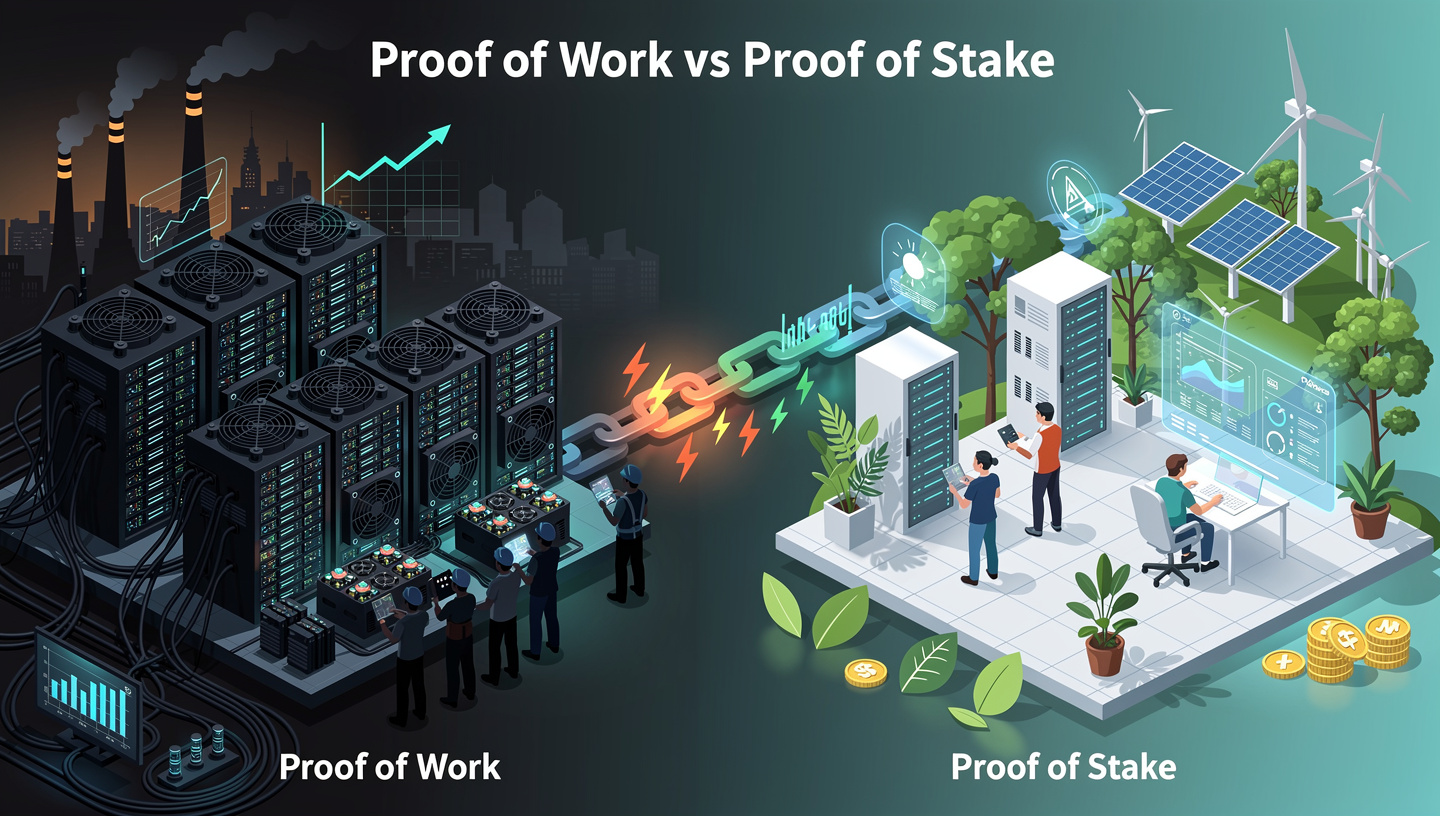
If blockchain is the engine behind cryptocurrencies, then consensus mechanisms are the laws of physics that keep that engine running. They determine who gets to add new blocks, how transactions are validated, and how the network protects itself from fraud.
Two models dominate today’s conversation:
- Proof of Work (PoW) — pioneered by Bitcoin
- Proof of Stake (PoS) — popularized by Ethereum’s major upgrade in 2022 and widely adopted by newer chains
Both systems aim to achieve the same thing:
A decentralized network where strangers can agree on what is true — without banks, governments, or centralized servers.
Yet they do so in radically different ways.
This article breaks down — clearly and realistically — how each works, where each excels, where each fails, and what the future likely holds.
1. Why Consensus Matters in the First Place
Without consensus rules, blockchain becomes chaos.
Imagine thousands of computers worldwide all keeping copies of the same ledger. At any time:
- Someone could try to spend the same coins twice
- Someone could try to rewrite history
- Someone could spam the network with fake transactions
Consensus mechanisms prevent this by enforcing:
- Order
- Fairness
- Security
They determine:
- Who proposes the next block
- How that block is verified
- What happens if someone cheats
This is where Proof of Work and Proof of Stake take different paths.
2. Proof of Work: Security Through Computation
How Proof of Work Actually Works
Proof of Work turns security into a math race.
Miners compete to solve cryptographic puzzles using specialized hardware. The puzzle is intentionally difficult, requiring significant electricity and computational power.
Steps simplified:
- Transactions are broadcast.
- Miners group them into a candidate block.
- Miners repeatedly guess numbers (nonces) until the block hash meets strict criteria.
- The first miner who solves it broadcasts the block.
- Other nodes verify the solution.
- The miner receives a block reward + transaction fees.
Why this matters:
- Cheating becomes extremely expensive.
- Rewriting history requires enormous computational power.
Advantages of Proof of Work
1. Battle-tested security
Bitcoin has run for more than a decade without compromise at the protocol level. The reason is simple:
To attack PoW, you must control more than 50% of global mining power — which costs billions.
2. Simple, transparent economics
Anyone can verify:
- Hash rate
- Difficulty
- Mining rewards
- Network security levels
The rules are predictable and public.
3. High resistance to manipulation
Because validators are tied to physical resources (hardware + electricity), control is harder to centralize through governance politics.
Disadvantages of Proof of Work
1. Energy consumption
PoW consumes large amounts of electricity. Supporters argue much of it is renewable or otherwise wasted energy. Critics argue that it scales poorly and creates environmental strain.
Both arguments have truth.
2. Slower transaction throughput
Because blocks take time to mine, PoW networks typically:
- Process fewer transactions per second
- Experience higher latency during congestion
3. Mining centralization risk
Over time:
- Industrial mining farms gained dominance
- Specialized ASIC hardware priced out hobbyists
PoW is decentralized in governance — but operationally, mining tends to cluster.
3. Proof of Stake: Security Through Ownership
How Proof of Stake Works
Proof of Stake removes mining entirely.
Instead of burning electricity, validators lock up tokens (stake). The protocol randomly selects validators to propose and validate blocks based on:
- Amount staked
- Randomization logic
- Network rules
If a validator behaves maliciously:
- Their stake can be slashed
- They lose rewards
- They may be expelled from the network
Advantages of Proof of Stake
1. Massive energy efficiency
PoS reduces energy usage by over 99% compared to PoW. No heavy hardware. No industrial mining farms.
2. Faster and more scalable
PoS networks tend to support:
- Higher transaction throughput
- Faster confirmations
- Lower fees (especially during normal usage)
3. Easier participation
Anyone with enough tokens (or through staking pools) can help secure the network. That democratizes earning opportunities — at least in theory.
Disadvantages of Proof of Stake
1. “The rich get richer”
Rewards are often proportional to stake. Large holders receive more rewards, compounding their control.
Without careful governance, PoS risks drifting toward oligopoly dynamics.
2. Attacks look different — and subtler
In PoS, power is not tied to machines — it is tied to wealth.
Potential risks include:
- Cartel behavior among large validators
- Governance capture
- Collusion to censor transactions
- Liquidity concentration through staking services
3. Slashing complexity and user risk
Staking incorrectly, choosing a bad validator, or failing uptime requirements can cause losses. The system is secure, but operational mistakes carry consequences.
4. Security: PoW vs. PoS — A Direct Comparison
| Dimension | Proof of Work | Proof of Stake |
|---|---|---|
| Primary security anchor | Physical resources (hardware + electricity) | Financial collateral (tokens) |
| Cost of attack | Enormous capital + ongoing operational cost | Large capital acquisition |
| Reversibility of attacks | Difficult, visible, expensive | Potentially easier if governance captured |
| Real-world track record | Over a decade of proven resilience | Newer, evolving, still maturing |
Neither is perfect. Each chooses different tradeoffs:
- PoW: Hard, costly, slow — but extremely robust
- PoS: Efficient, flexible — but dependent on incentives and governance
5. Decentralization: Who Really Controls the Network?
In Proof of Work
Control tends to concentrate where:
- Electricity is cheapest
- Hardware capital is high
- Industrial mining pools dominate
Yet miners cannot easily rewrite rules without full-node consensus.
In Proof of Stake
Control tends to concentrate where:
- Large token holders aggregate
- Staking pools dominate
- Custodial platforms stake on behalf of millions of users
This means PoS sometimes functions closer to financial governance than hardware-based governance.
6. Environmental Debate: Beyond Simplistic Narratives
It is easy to say:
- “PoW destroys the planet”
- “PoS is magically perfect”
Reality is far more nuanced.
PoW often uses:
- Stranded hydro
- Excess wind and solar
- Flared natural gas that would otherwise burn uselessly
PoS undeniably reduces consumption, but pushes risk into centralized staking infrastructure and complex governance mechanisms.
Both models are evolving to address weaknesses.
7. Which Is Better — PoW or PoS?
The honest answer:
It depends on what you value.
Choose Proof of Work if your priorities are:
- Maximum neutrality
- Censorship resistance
- Long-term, conservative security
Choose Proof of Stake if your priorities are:
- Efficiency
- Speed
- Lower environmental footprint
- Easier participation
Many analysts expect a world where:
- Bitcoin continues representing hard, conservative digital money
- PoS chains dominate smart contracts, DeFi, NFTs, and high-speed applications
Different tools, different jobs.
8. The Future: Hybrid and Adaptive Consensus Models
Innovation is accelerating. We are already seeing:
- Hybrid PoW/PoS systems
- Checkpointing models
- Restaking and shared security
- Rollups and modular chains layered over base networks
Consensus is no longer a binary conversation. It is becoming a portfolio of mechanisms, optimized for different use cases.
Final Thought
Proof of Work and Proof of Stake each embody a philosophy.
- PoW: Security anchored in the physical world.
- PoS: Security anchored in aligned economic incentives.
Neither is inherently “right” or “wrong.” The real challenge — and opportunity — lies in understanding the tradeoffs and deploying the right architecture for the right mission.